

One Wednesday evening after a Dharma talk, someone asked the question, “How does zen practice help me deal with my suffering/strong emotions?
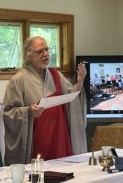
Ji Do Poep Sa Nim Terry Cronin answered in this way.
“One way to describe Zen practice is that it is honing our ability to be aware, simultaneously, of what is happening “inside” us—our ever-changing flow of thoughts, feelings, emotions, sensations (in our tradition, we refer to that as our “condition”) and outside but proximate to us (we refer to that as our “situation”). Zen means keeping a clear mind in each moment, which means perceiving clearly each moment: see clearly, hear clearly, smell clearly, taste clearly, touch clearly. The “moment” is our experience of what is both inside us and outside us. How much can we be aware of ALL of it? If we are awake, perceiving clearly, then we can be clear what response to the situation might be skillful. Then, we can just do it.
Strong emotions often seem to take control of us. We experience a strong emotion, which triggers our grasping/aversion reactions and our like/dislike thinking. We try to hold onto and keep what we like; we try to push away and reject what we don’t like. For example, imagine you are sitting in meditation and a person sitting nearby is fidgeting repeatedly. You might feel impatient and irritated, thinking, “Why can’t they just sit still. They’re distracting me. How will I ever feel calm and blissful with them squirming around all the time. The Head Dharma Teacher should correct them, make them stop moving so much.” You start to feel more and more angry—at the person for fidgeting, at the HDT for not correcting them—which fuels more negative thoughts and feelings. Often, this snowballing happens so rapidly that we don’t even notice it until we are well down the path. We may not even become aware of how upset we are until we’re on the verge of screaming out loud, “STOP MOVING, WHAT’S WRONG WITH YOU. IF YOU CAN’T BE STILL THEN JUST LEAVE!!!”
If we practice sincerely, we hone our ability to be aware of these thoughts, feelings, emotions, etc. closer and closer to when they first arise in us—before they have snowballed into stronger, more extreme versions. We can more quickly become aware of whatever is arising in our mind and let it go by returning our attention to our practice method—whether that be breath counting, or mantra, or clear mind/don’t know, or just sitting. We’re responding skillfully to the situation earlier in the process, when the emotional energy is much lower and less likely to be controlling us. We’re also more likely to feel compassion for the person/situation. “Oh, they’re really struggling. Let me sit more strongly, perhaps that will help them.” So, that is one way that sincere practicing can help us deal with strong emotions.”